Education
Explore resources on toddler behaviors

About Toddlers
During the toddler years (ages 1–3), children’s brains, bodies, and abilities develop rapidly. For parents, these years can be exciting, challenging, and sometimes overwhelming. Behavioral issues like tantrums, picky eating, sleep struggles, and difficulty sharing are common toddler behavior issues.
Toddlers also reach developmental milestones at their own pace, and each child is different. If you have concerns about your child’s development, it’s important to talk to your pediatrician. Early intervention can make a big difference in supporting healthy growth and managing toddler behavior.
Toddler Basics
No two toddlers are the same, but most kids in this age range share some developmental similarities. Know what to expect and how to help these youngsters develop language skills, test the waters of independence, and more.
ou come home from a walk and tell your toddler, “Okay, time to put your shoes away.” Seems pretty straightforward, right? Not if you’re two.
Toddler communication is its own special language, one that isn’t always intuitive for parents. We asked our experts what parents can do to make talking to toddlers more effective and less fraught. As the mother of an almost-three-year-old I was pretty eager to hear what they had to say.

Give clear directions
When talking to toddlers, the way you communicate is just as important as what you’re trying to say, explains Laura Phillips, PsyD, a clinical child psychologist. The clearer the directions, the more likely you are to get the desired result.
“Be specific when you give directions, and don’t assume kids know what you’re talking about, even if it seems obvious to you,” says Dr. Phillips. To us it might seem obvious that “put your shoes away” means: Take your shoes off and put them in the closet. But to a toddler who lacks the knowledge (or attention span) to fill in the steps, the direction can be confusing. Toddlers are also easily distracted and can get overwhelmed by strings of instructions, making it less likely they’ll complete the task as directed.
If you’d like your toddler’s help cleaning up, you might be tempted to say: “It’s time to clean up. I need you to pick up your toys and put them away.” Instead, try breaking the instructions into smaller requests, making sure to offer positive reinforcement along the way when kids do as they’re asked. For example: “Please pick up the blocks and put them in the bag.” Then when that’s finished: “Great! Now pick up that green book and put it back on the shelf.”
Label and validate their feelings
As a general rule, toddlers don’t have much control over their lives. And that’s good. If they did, the world would resemble a Godzilla movie. But, as their brains develop and they become more independent, that lack of autonomy can cause friction. Kids’ desires and feelings are real and valid, even though (obviously) you can’t always let them have their way.
When kids get upset, whether it’s about something understandable, like a skinned knee or losing a favorite toy, or something that seems ridiculous — Are you seriously crying because your water cup is blue not red? — it’s important to remember that toddlers are people. Tiny, adorable, irrational people, but still. For a child who’s just learning to make sense of the world, those experiences and the feelings they provoke are as intense as any an adult has.
“Kids need to know you’re taking their feelings seriously,” says Dr. Phillips. “So it really helps to label and validate how kids are feeling.” This can be as simple as saying: “I know you want that cookie right now. I can see you are mad,” she says. Showing your child that you’re taking their feelings seriously, and helping them put words to their emotions, can help defuse potential tantrums and make it easier for them to explain their feelings more effectively next time.
Offer choices
Another way to honor toddlers’ burgeoning independence is to offer choices instead of issuing declarations, says Dr. Phillips. “Whenever it’s reasonable, try giving kids limited choices. For example, when it’s time to get dressed you could say: ‘Do you want to wear your tiger shirt or your dinosaur shirt?’ If a child is lobbying for a treat, you could say, ‘Well, we can’t eat cookies right now. But I can offer you some fruit. Would you like blueberries or strawberries?’”
Finally, Dr. Phillips says sometimes letting your child’s will prevail is an appropriate way to keep the peace. “Pick your battles,” she says. “Sometimes, as parents we’d like something to happen, but we don’t need it to happen.” Choosing what is, and isn’t, worth going to the mat for will also help kids understand that when you do decide to draw the line, it’s important to listen.
Keep it consistent
Toddlers like repetition, whether it’s watching the same movie 500 times, asking you to read a beloved book over and over, or demanding to hear a song “again!” Annoying as it may be to parents, repetition helps kids learn, absorb information, and make sense of the world.
“Consistency in the language you use is important,” says Alexandra Levine, MS, a speech-language pathologist. “Using the same language and backing it up by keeping the meaning consistent makes it easier for kids know what to expect, and means they’re more likely to understand and listen to what you’re asking them to do.”
To paraphrase Dr. Seuss, this means that parents should say what we mean and mean what we say. “Make sure you can follow through with the direction before giving it,” Levine explains. “Staying consistent and predictable helps toddlers understand that, for example, when we say, ‘This is the last book,’ it really is the last one.”
Consistent language works best when everyone is following the same playbook. Parents should make sure they’re on the same page around language and rules — that is, “five more minutes” needs to means five more minutes period, regardless of who’s saying it.
Levine also recommends sharing language you use at home with other caregivers, like babysitters or grandparents or even your child’s teachers, especially if there’s a specific behavior (like not hitting, cleaning up or taking turns) you’re working on at home. “Saying, ‘Hey, this is something we say at home when this behavior comes up,’ can help underline the rules and values you’re trying to communicate even you’re not there,” she says.
Positive attention
A red-faced parent yelling “Stop that right now!” may not be quite the same as a smiling one offering hugs and praise, but to a toddler, attention is attention. When kids are misbehaving, it can be hard not to show your (perfectly reasonable) frustration: “Hey! No throwing!” But when parents give big reactions to bad behaviors, they may unconsciously be giving kids incentive to keep acting up.
“As parents, we often give a lot of attention to behaviors we don’t want to see,” says Dr. Phillips. Instead, parents should focus on praising behaviors we do want, and try to redirect kids to more appropriate actions. For example, says Dr. Phillips, “if a kid is drawing on the wall, instead of yelling, ‘Don’t color on the walls!’ try telling your toddler what you do want them to do, like ‘Please color on this piece of paper,’” and offering praise when they do what you’ve asked.” Heaping positive attention on desirable behaviors (like listening) helps reinforce them, and makes undesirable ones (like smearing yogurt on the carpet) less appealing.
Be specific about safety
Repetition, consistency, and clarity are especially important in situations where there’s no room for misunderstanding. Doing some preparation when things are calm and kids are receptive can help. Asking kids who are verbally capable of doing so to repeat important directions back to you (and praising them when they do) can also help reinforce the message. For example, before heading out to the park, you might say, “Okay, remember what you do every time before we cross the street?” and ask your child to respond with “hold your hand.”
In the moment, make sure to use clear language that’s specific to the situation. For example, if your child is close to the street, just saying “Stop!” — a word most toddlers hear several thousand times a day — isn’t likely to get the immediate response you’re looking for. Instead, you could try “Stay on the sidewalk!” Likewise, if something is hot or sharp, instead of the oft-used “Don’t touch that,” try “Dangerous! Hands off!”
Take space when you need to
As the mother of a toddler I know that even the most perfectly conceived strategies quickly go out the window when Bad Moods are in play. What works when kids (and parents) are calm and receptive can be hard to stick with when your toddler is melting down and your patience is hanging by a thread. “In those situations, it’s good to step back and either tag in your partner or just take a break and a breath before coming back,” says Dr. Phillips. “Moments when kids or parents or both are upset are not the time to press your point.”

Give yourself some grace
That said, there are going to be times where you lose your cool and snap. It’s something we all do, and something no one feels proud of. But instead of beating yourself up, think of it as a moment to model positive coping skills.
“Parents make mistakes,” Dr. Phillips says, but those not-so-proud parenting moments can actually be opportunities to model important emotional skills. “Maybe you got frustrated and snapped at your kid,” she says, “You can go back in a little bit and say, ‘You know what? I made a mistake a little while ago. I was feeling frustrated and I spoke a little too loudly and I’m sorry.’” Acknowledging mistakes and making amends is a great way to show kids how you’d like them to behave, too.
Toddler Behavior
Tantrums are a hallmark of toddler behavior — they don’t call them the terrible twos for nothing. Here you’ll find resources on why these challenging behaviors happen and what to do — and not do — in response.
How to Discipline Toddlers
As they test their independence, setting and enforcing limits lays the groundwork for good behavior.
When and how should you begin to discipline toddlers?
Kids begin knowing what “no” means at around seven months on average, and, once they can speak, many go through a stage where it becomes their favorite word to use. Unfortunately, parents can also count on kids going through a stage where they gleefully ignore when mom or dad says no, and other attempts and discipline. That’s because it is natural for them to start pushing boundaries — testing their independence and trying to explore the world on their own terms.
Why discipline is important
A big part of discipline in the early years is simply keeping kids safe. We don’t touch the oven. We don’t pull on the cat’s tail. We don’t run into the street. But by setting consistent limits early, parents are also laying the groundwork for good behavior in the future.
Setting limits has other benefits, too. Telling children which behaviors you do — and don’t — want to see actually makes kids feel more secure, because it reminds them that you’re in charge and guides them to the areas where they should be developing their skills and independence (such as playing with the plastic tea set and not trying to touch the real one.)
Rules are also a way to help kids begin to consider the perspective of others, or at least set the stage for empathy. Two-year-olds might be too egocentric to comprehend how others feel, but they can begin to learn that sharing is a nice thing to do and practice handing grandma a toy.
But how should parents share rules with children, and how can those rules be enforced — particularly when children are very young and might not understand the concept of consequences?
Setting routines
Kristin Carothers, PhD, a clinical psychologist, says that parents are probably already setting limits without realizing it. “One of the most naturalistic ways to create boundaries is around having set routines for your kids,” says Dr. Carothers. “They might not know what time it is, but they know the bedtime routine — we have our bath, we read our book, we go sleep in our own bed.” By creating a familiar routine, parents are teaching children what to expect next, so there are no unpleasant surprises, while also establishing a clear boundary about when the bedtime begins.

Discipline toddlers in the moment
Of course, much of life isn’t planned for, so parents need strategies for how to correct behavior and reinforce boundaries in the moment. “If there’s a rule you want followed, like not hitting, then that is something you have to correct in the moment when you see it,” says Dr. Carothers. But how you correct it matters.
Parents often say, “Don’t do that” or “No,” but Dr. Carothers says that it is actually more helpful to tell children what you do want them to do, instead. “Kids know what ‘no’ means, but they don’t necessarily know what to do next after we say no, so you always want to make sure that you have an alternative for them,” she explains. Saying, “Keep your hands to yourself” or “Use gentle hands” makes that clear.
For children around three years old, parents might have the child do a time out for something like aggressive behavior. Dr. Carothers explains time-out as being “time-out from your positive attention.” So you might say, “We keep our hands to ourselves. You hit your brother, so now you have to sit in this chair.” For kids who are young, time-out shouldn’t be longer than three minutes. Then, after the time out is finished, you can tell the child what they should do next: “You can ask your brother for the toy” or “You can touch your brother gently.”
Parents can also start setting natural consequences for a child’s misbehavior. For example, if a child jumps on the couch, a natural consequence could be having them practice sitting calmly on the couch. If they write on the wall, then you could have them wash the wall. Of course they might not actually get the wall clean, but just the act of trying to wash the wall reinforces your rules.
Keeping expectations realistic
For some situations, relying on your ability to respond in the moment might not be enough. For example, toddlers will run into the street if they see something interesting and not realize the potential danger. “We can’t expect a toddler to set that limit for themselves,” explains Dr. Carothers, “so you as a parent need to do the intervention on the opposite side.”
For walking on the sidewalk, that means you need to hold your toddler’s hand at all times to keep them safe. Dr. Carothers also encourages parents to say something like, “Good job holding mommy’s hand! Thank you for staying close to me,” which lets your child know that these are the types of behaviors that you like to see.
Consider what your child is developmentally able to do, and what they aren’t. Just as walking safely outside might be unrealistic, so might expecting them to be well behaved during a boring (for them) social function. “As parents we have to manage our expectations,” says Dr. Carothers.
For example, toddlers are very egocentric, so it is developmentally appropriate for them to be more concerned about getting their own needs met than sitting quietly at dinner. There are ways to promote good behavior — give them lots of praise for sitting in their seat, have things for them to do while they’re sitting, take breaks — but now probably isn’t the time to take them to a place where perfect manners are expected.
Responding to tantrums
This is also the age when kids start having tantrums. There are a few reasons for this. Young children are still learning how to communicate, and their language abilities aren’t very sophisticated yet. “A child might act aggressively in the absence of developed language to communicate feelings like frustration, anger, or embarrassment,” explains Dr. Carothers.
But a child might also throw a tantrum because they have noticed that when they act very upset people tend to respond and, more often than not, they get what they want. That’s why it’s important to ignore tantrums — even when they’re embarrassing. Giving in to a child’s tantrum inadvertently reinforces the behavior that they used to get what they wanted, and that is not something that you want to encourage. Instead, parents should wait for their child to calm down and then immediately praise them for being calm.
Dr. Carothers gives an example. “Say you’re leaving the grocery store and your child starts throwing a tantrum in the parking lot because he wants Goldfish. You can say, ‘Thank you for telling me you want Goldfish; I like Goldfish too. Next time we go to the store we can get some Goldfish.’ ” If your child doesn’t stop tantruming, Dr. Carothers recommends to let it play out and don’t give in, even if you’re tempted. Besides not wanting to reinforce tantrums as an effective negotiating tactic, Dr. Carothers points out: “It’s good for us to teach kids that there are times when we’ll get what we want and times when we won’t get what we want. That’s a natural part of life.”
Satisfying the need for control
Children this age may also act out because they want to feel more control. And it is developmentally appropriate for toddlers to start making more decisions and being more independent — within reason. Dr. Carothers agrees that kids should start making more decisions as they get older, but cautions that they should be limited to making “the developmentally appropriate decisions that a toddler should be making.” In other words, your two-year-old can pick which game they want to play, or which show they’d like to watch, but they shouldn’t be deciding how long they get to watch television or whether or not they have to take a bath afterwards. Those are adult decisions.
What NOT to Do When Your Child Is Having a Tantrum
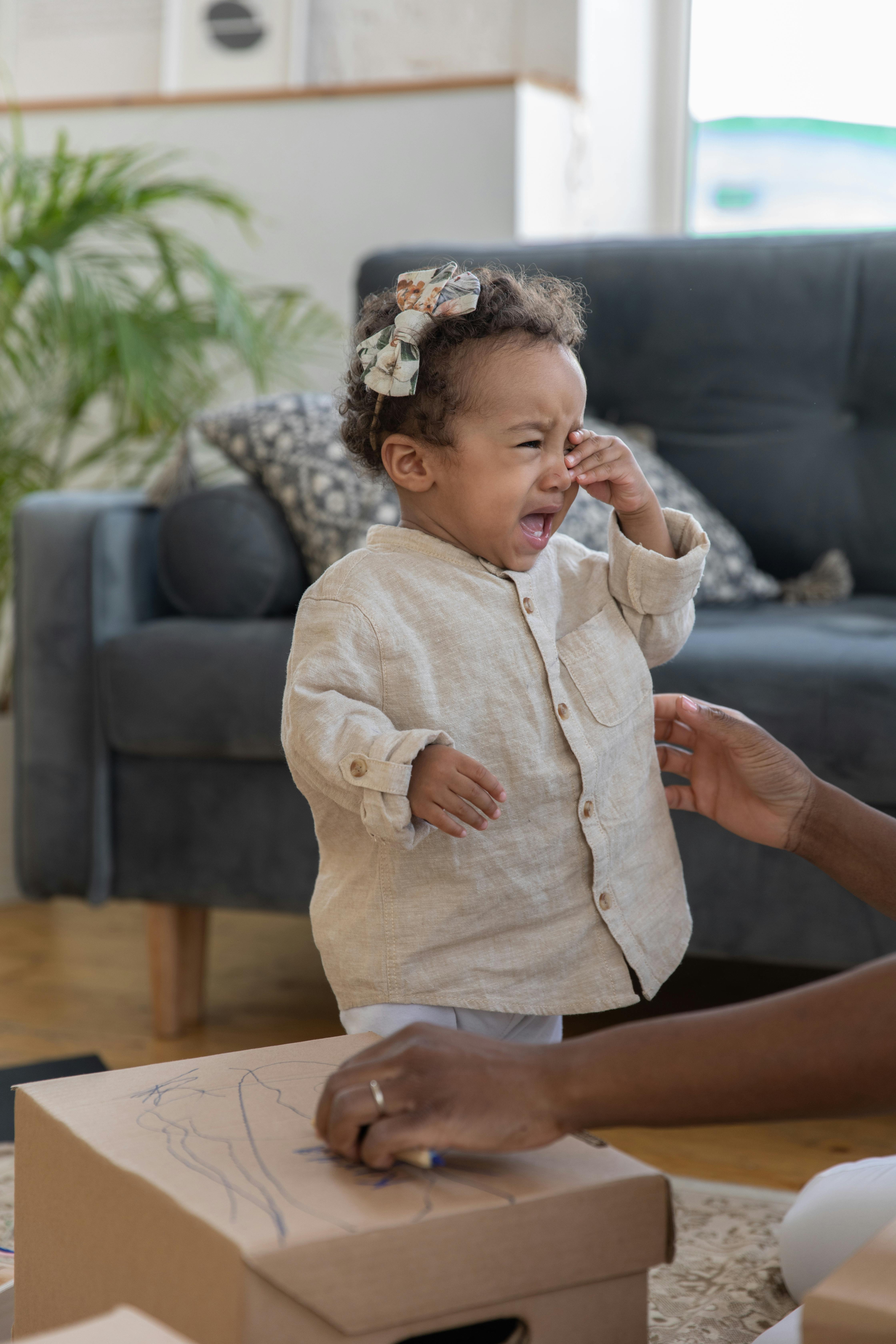
Even when we know, as parents, how we should respond to a tantrum, in the heat of the moment we find it hard to resist doing the wrong thing — something that not only doesn’t work but makes things worse. Taking a moment to consider why it’s particularly crucial to avoid these responses, with some tips on how to do so, can help cement your resolve not to turn to them reflexively.
DON’T invalidate your toddler’s perspective or emotions.
When parents describe their toddler’s tantrums, they frequently speak in an incredulous tone. “She completely freaks out over the smallest thing!” Parents constantly use this word, “smallest,” and the many synonymous words and phrases — “littlest,” “most unimportant,” “most trivial” — to describe the things that trigger their child’s tantrums. On their face, the reasons toddlers throw tantrums can be patently absurd.
And yet, when we are with our children, it’s important that we don’t laugh, that we take their reactions and experiences seriously. Some examples of invalidating reactions, aside from blatantly laughing at your child, include:
- “X is not a big deal.” When in the history of the world has this ever worked with anyone? Your toddler or preschooler will never say, “You know what? You’re right, Mom. It’s totally not. My bad — blew it way out of proportion.” Frankly, it’s not just kids. No one responds this way. Ever.
- “Oh come on, it’s only X.” The “only” here is the big clue that you are patronizing your child by discounting whatever it is she’s upset about. The word “just,” in the same context, is also a giveaway. Be on the lookout for those words — even when said in a seemingly empathic tone — when your little one is falling apart.
- “There’s nothing to get so upset about.” Again, think about your own experiences with being upset. Is it ever helpful to be told you’re upset for no reason? No. Either you believe there is a good reason to get so upset or you’re aware of the absence of a “reason” from a logical standpoint, and yet you’re upset anyway. And now you’re also ashamed of being upset, since apparently there’s nothing to get upset about.
- “You’re being ridiculous.” This one pretty much speaks for itself. No one likes to be told he’s being ridiculous, whether age two or 42. The same goes for words like “unreasonable” and “irrational.”

DON’T tell your child how to feel.
This is a great general rule (to apply to toddlers, preschoolers, and the rest of humankind) and is particularly relevant for tantrums. These are comments that not only invalidate young children’s emotions and experiences but also instruct them to feel something different than they do — for example, “Don’t be angry,” or “Stop getting so upset!”
I see this a lot around play, particularly when children are attempting to master a skill, such as constructing a building out of blocks or drawing a (more) perfect circle. Often, during these activities, children scream or cry when they “mess up,” prompting parents to rush in to “help,” also known as “do whatever it takes to avoid a meltdown.” Parents immediately tell their child that there’s “nothing to get upset about,” or that they “can try again.”
Although these comments sometimes work to stave off a tantrum in the moment, I’ve often seen young children get even more upset in response. In contrast, however, they frequently calm down when parents simply help label their feeling or describe the circumstance at hand. “You’re frustrated that it looks more like a rectangle than a circle, huh?” or “You were working so hard, and then the dog came over and ruined it.” When children have the opportunity to have their emotions heard and understood by their parents, they feel soothed and no longer have to demonstrate their distress with louder screaming or harder crying.
If, on the other hand, they are told often enough not to feel what they feel, toddlers and preschoolers may come to believe that they have the ability to switch their emotions on and off on a dime or — more accurately — that they should be able to do so. And not only should they have this magical power, but they should exercise it not when they want to, but when their parents want them to. Young children need to learn that their feelings are part of life — even the difficult ones — and that they come and go, like waves in an ocean we need to ride (an analogy I didn’t make up but often invoke). As parents, we need to model and teach them how to cope with these feelings, not how not to have them, which, frankly, won’t work anyway. Also in this category: “Relax!” and “Calm down!” Just stop saying that. To everybody. Period.
DON’T lie to your child to head off a tantrum.
Often parents lie — or, ahem, tell half-truths — to avoid simply saying no and having their child experience (and express, likely in tantrum form) disappointment or frustration. Are there times when a little fib is OK? Yes. Once in a while, you can, of course, tell your toddler or preschooler that there are no more cookies, even though you know there’s another unopened box in the pantry. But telling your child that the iPad is broken (when you just don’t want him to use it) or that the toy store is closed (when you just don’t want to stop there on the way home) doesn’t do your child, or you, any favors.
Well, that’s not quite true. It does do you a favor in the short run, as the following 10 minutes will undoubtedly be easier than they might otherwise be. And occasionally you may — for whatever reason — need to prioritize those 10 minutes. But in the long run, getting in the habit of relying on these untruths sets a pretty lousy precedent. If you want your child to be honest with you, you need to be honest with her. Because sooner or later she’s going to realize that the iPad doesn’t just spontaneously break at a certain time each day, and then what will she start thinking about all the other things you’ve been telling her? Children need to see parents taking responsibility for setting limits in an open and clear way, which means you need to practice.
DON’T say that your child’s behavior is making you sad.
I’ve heard this one a lot over the years. A child will begin to get angry or upset about something, and a parent will respond by making a sad face or pretending to cry, remarking, “You know it makes me so sad when you act like that.” Children are not responsible for their parents’ emotional well-being. This road goes in a single direction, and it’s the other one: parents are responsible for their children’s emotional well-being. Because of this, attempting to motivate your toddler’s behavior by noting the effect on your feelings is a slippery slope. Will it be important for him to learn that his behavior affects other people? Of course. Nonetheless, it’s developmentally inappropriate to ask that he act a certain way out of a sense of responsibility for your feelings.
While we’re on this topic, I’d cut the whole sentence construction — “you are making me feel X” — from your interactions with your child more generally. The phrasing implies that your child has a whole lot of power, which can feel overwhelming and ultimately lead to anxiety. Saying “I am starting to feel frustrated/angry/upset” is preferable, as the wording implies that your feeling states are your own and models your ability to recognize and label them, then act accordingly — a skill your child will benefit from learning himself.
DON’T take tantrums — and the things your child says before or during them — personally.
Q-TIP is a great acronym (and one whose origin I don’t know). That is: Quit Taking It Personally. Write this down, laminate it, and hang it on the wall in every room. Or set an alarm to go off on your phone that reminds you of this every hour on the hour. When your toddler or preschooler is having a tantrum, she may well pull out all the stops. What does that look like? “I hate you!” “You’re a bad mommy!” “I want Daddy, not you!” “Go away!” “You’re mean!” These things are never easy to hear, especially from your own child. And yet these comments are appropriate expressions of anger for children this age.
Becoming angry and responding in kind — “You’re mean, too” or (I heard this once) “You’re meaner” — does nothing to help alleviate your little one’s distress and will undoubtedly escalate the situation. It also implies that the two of you — you and your child — are expected to adhere to similar standards of behavior, which is both false and confusing.
I also don’t recommend commenting on your child’s decorum or manners in that moment — “Don’t talk to me that way” or “Stop being so disrespectful.” Sure, your job is to teach your child to be respectful and have good manners, but doing so in this way, at this moment, will almost guarantee that he doesn’t actually hear the message.
DON’T use sarcasm.
Although somewhat ubiquitous in this day and age, sarcasm is a rather sophisticated form of communication and one that young children are not able to understand. They may pick up on the fact that your tone doesn’t match your words (such as when “very funny” is stated in a bitter or ominous way), but they won’t know what to make of that. Sarcasm is frequently confusing for toddlers and preschoolers, as well as belittling. Some examples of sarcastic comments I have heard from parents leading up to or during their child’s tantrum:
“Yes, and I want world peace.”
“Your life is just so hard.”
“I know! It’s the end of the world!”
“Because [insert whatever here] is so clearly the most important thing on the planet.”
At best, your toddler or preschooler will feel confused by your use of sarcasm when he is upset. At worst, he will feel demeaned. Either way, it’s an almost certain bet that his distress will go up and the tantrum will get worse and not better.
I want to draw your attention to the fact that “lose your temper” did not make this list of don’ts. Does this mean that I recommend your completely losing your temper the next time your toddler has a meltdown? Of course not. But the reason I didn’t include it here is that at some point — maybe not tomorrow or next week — you will. And what’s more? At some point you already have. You raised your voice louder than you meant to, or said something you still regret. Even after you finish this book, you’ll find yourself back there again; you’ll take a nasty tone with your toddler or preschooler, or somehow let a curse word slip out. Both you and your child will survive, and the thing about parenting is that you’ll get another chance — so many other chances — to get it right.